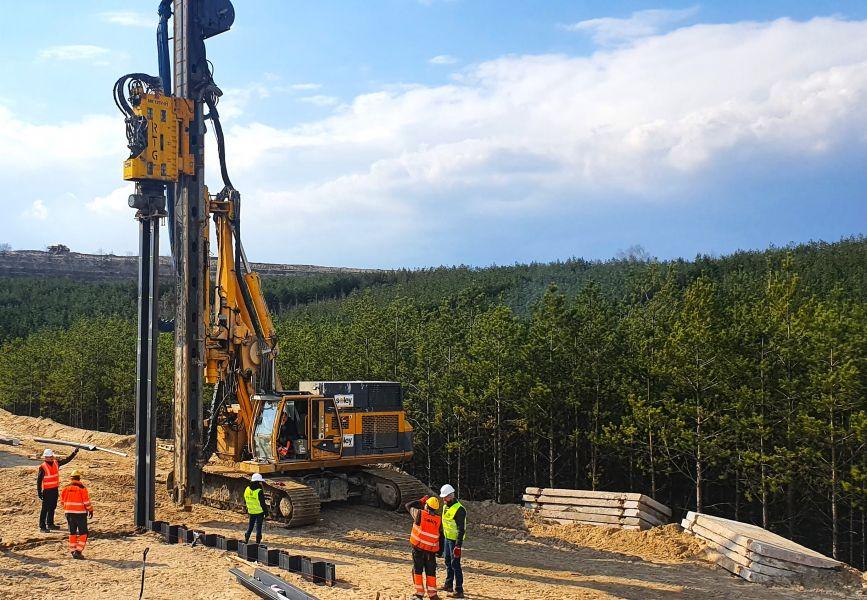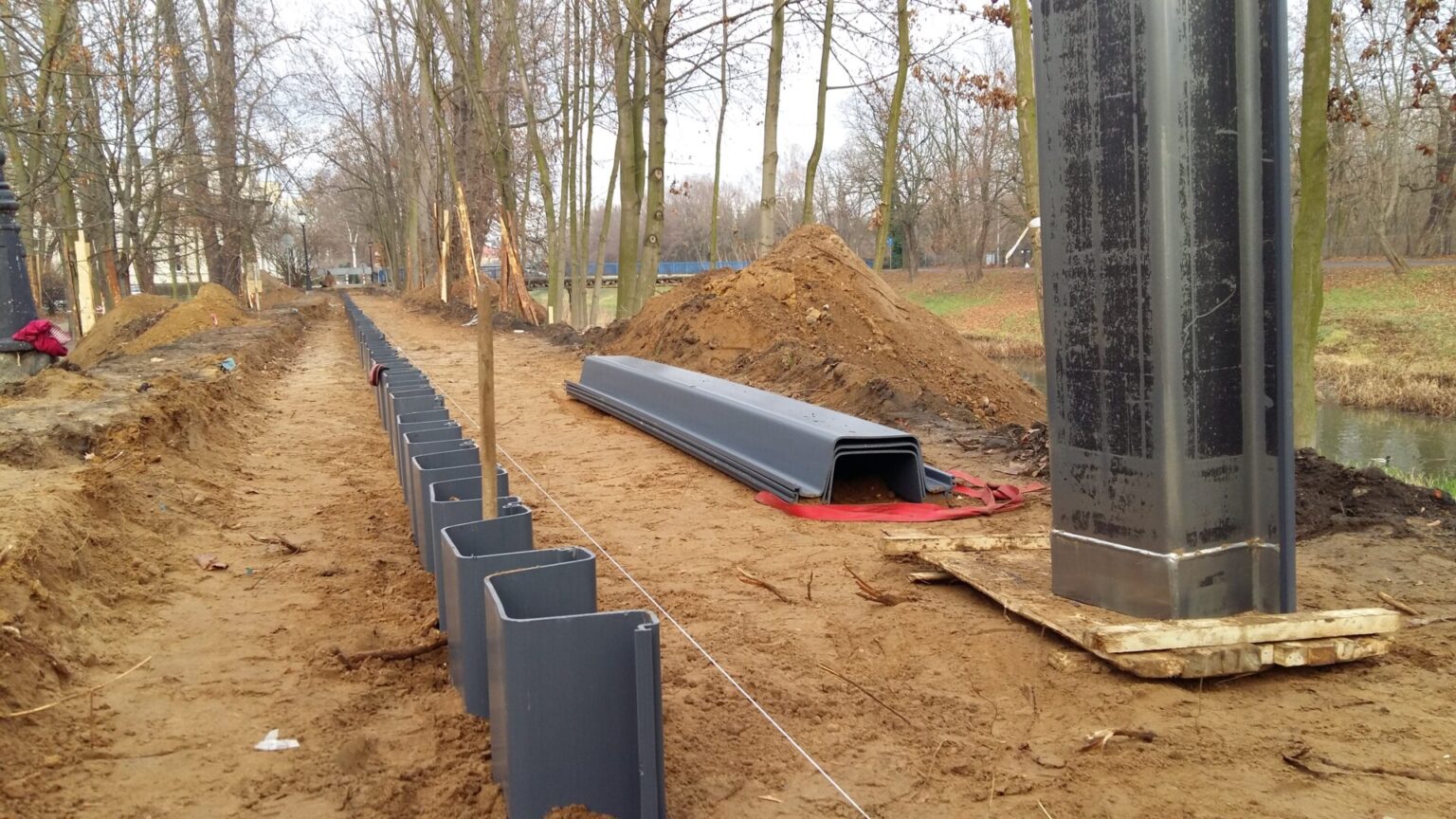
Vinyl sheet piles have become a common solution for many engineering applications, thanks to their durability, resistance to corrosion, and ease of installation. It must however be remembered that owing to the specificity of the thermoplastic material, certain aspects of vinyl sheet piles design process require special approach compared to traditional steel counterparts.
Vinyl Sheet Pile Design Specificity
Due to the significantly lower Young’s modulus of PVC compared to steel, and consequently greater deformability of vinyl sheet piles, special attention must be paid to displacement analysis. Such material property makes the allowable displacement rather than the stresses the critical factor determining dimensions in designing structures involving PVC sheet piles, especially in the case of cantilever walls. Displacements in the sheet piles directly influence the performance of the structure in the retaining soil, its resistance to water pressure, and the overall stability. Key factors that determine displacements include:
- Soil properties: The type, density, cohesion, and friction angle of soil significantly affect how the sheet piles interact with the ground. Different soil conditions, such as sandy, clayey, or mixed strata, can lead to highly variable displacement behaviors, underscoring the importance of accurate soil characterization.
- Water table level: Hydrostatic pressure from groundwater can induce additional forces, affecting displacements. Seasonal fluctuations in the water table further complicate these calculations.
- External loads: Surface loads, such as traffic or construction activities, may exert lateral forces on the piles.
The variability of displacements across different ground conditions makes precise estimation crucial. For example, loose sands may experience greater lateral movements than stiff clays under similar loading conditions. Advanced numerical modeling and analytical methods, supported by field measurements, are essential to predict displacements accurately and optimize the design of vinyl sheet pile systems.
Norms and standards serve as a guiding framework to ensure safety, reliability, and consistency in engineering practices. For vinyl sheet pile projects adherence to the following standards is particularly important:
- PN-EN 1997-1: This standard provides guidelines for geotechnical design, including principles for analyzing soil-structure interaction and calculating displacements.
- PN-EN 1997-2: This standard outlines procedures for site investigations, laboratory testing, and field measurements. It emphasizes determining soil properties to support precise displacement analysis.
- Local Regulations: In Poland, the Rozporządzenie Ministra Transportu, Budownictwa i Gospodarki Morskiej z dnia 25 kwietnia 2012 r. specifies the requirements for determining geotechnical conditions for construction projects, including categorizing geotechnical complexity.
Compliance with these norms ensures that the design accounts for all potential risks, providing a reliable foundation for the project.
Accurate Displacement Estimation
Ground investigation should be treated as the cornerstone of any geotechnical project with the primary objectives of such analysis including:
- Characterizing soil types and properties: determining the composition, strength, and deformation parameters of the soil layers. For instance, sandy soils may require different considerations compared to clayey soils due to their varying drainage and compaction characteristics.
- Identifying geological hazards: detecting potential risks such as liquefaction in loose sandy layers, sinkholes in karst terrains, or landslides on steep slopes that may compromise the project.
- Assessing groundwater conditions: understanding the water table level, seasonal variations, and hydrostatic pressure is crucial for evaluating seepage forces and designing effective drainage systems.
A comprehensive ground investigation involves several steps:
- Desk/preliminary research: reviewing historical data, geological maps, and previous site investigation reports to understand general conditions.
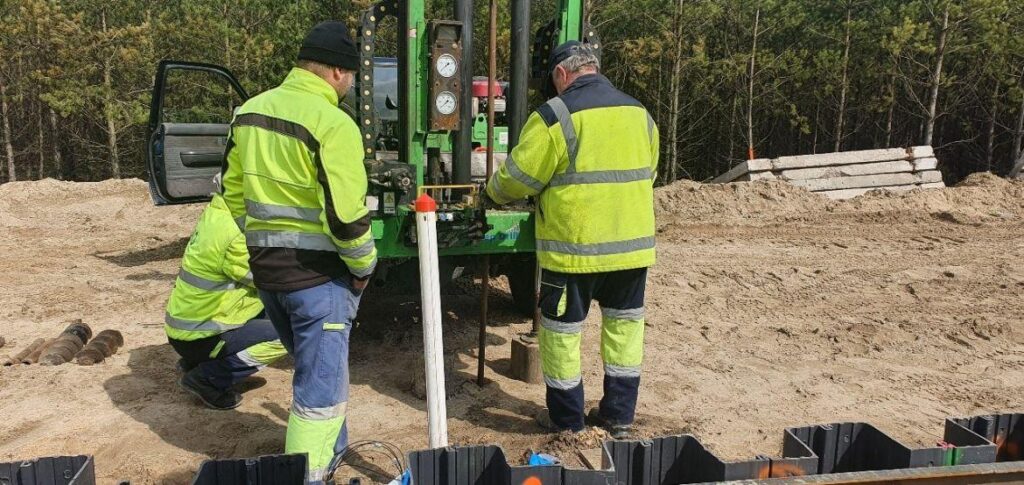
- Field investigations: conducting borehole drilling, soil sampling, and in situ tests such as the Standard Penetration Test (SPT), Cone Penetration Test (CPT), and vane shear tests for soft clays.
- Laboratory testing: analyzing soil samples to determine mechanical properties, such as shear strength, compressibility, and permeability; tests like triaxial compression and consolidation tests provide detailed insights.
- Reporting: compiling findings into detailed documentation, including geotechnical reports, stratigraphic profiles, and recommendations for design and construction.

Proper documentation derived from ground investigations serves as the foundation for:
- Selecting appropriate construction methods: for example, determining whether pre-drilling is necessary in dense soils to facilitate vinyl sheet pile installation.
- Designing safe and cost-effective foundations: tailoring designs based on soil bearing capacity and settlement potential.
- Planning excavation support and dewatering systems: ensuring stability during construction by addressing seepage and soil strength reduction due to groundwater.
By incorporating insights from detailed investigations, engineers can mitigate risks and optimize the performance of vinyl sheet pile structures.
Ground conditions play a pivotal role in displacement analysis. The stiffness, strength, and drainage characteristics of the soil dictate how sheet piles interact with the surrounding medium. For instance:
- Soft Clays: these soils often result in higher displacements due to their low stiffness and high compressibility. Accurate estimation of undrained shear strength and consolidation parameters is vital.
- Dense Sands: while offering higher resistance, dense sands can still exhibit notable displacements under dynamic or cyclic loading. Determining the relative density and angle of internal friction is crucial.
- Layered Soils: mixed strata introduce complexity, as contrasting stiffness and strength parameters can lead to differential movements. Detailed profiling and parameter estimation are essential to mitigate risks.
Based on Eurocode 7, the minimum investigation depth is:
- 2 meters below the lowest point of the foundation or excavation in favorable geological conditions.
- 5 meters below the lowest point if the geological structure is unknown.
- Deeper if weak soils are present, ensuring the properties of underlying strata are well understood.
Investigation points must be strategically located to capture the full variability of ground conditions. For linear or slope-adjacent structures, extended investigation zones are necessary to assess slope stability and fault lines. The recommended spacing of investigation points is 15–200 meters, varying with project type, foundation type, and geological complexity. Incorporating high-quality geotechnical data into displacement analysis models ensures:
- Improved Predictive Accuracy: reliable inputs lead to realistic deformation predictions, preventing underestimation or overdesign.
- Enhanced Safety Margins: identifying critical conditions reduces the likelihood of failure or serviceability issues.
- Cost Optimization: avoiding unnecessary conservatism in design translates to material and execution savings.
Summary
The foundation of accurate displacement analysis lies in comprehensive ground investigation. By understanding and accounting for site-specific soil behavior, engineers can ensure safe, efficient, and cost-effective designs. For projects involving vinyl sheet piles, calculating displacements with precision, adhering to norms, and conducting thorough ground investigations are non-negotiable elements of the design and construction process. These practices not only ensure structural integrity but also contribute to sustainable and cost-efficient solutions. By prioritizing these aspects, engineers can confidently address the challenges of complex geotechnical environments and deliver successful outcomes.
References
- Eurocode 7: Geotechnical Design – Part 1 (PN-EN 1997-1:2008)
- Eurocode 7: Geotechnical Design – Part 2 (PN-EN 1997-2)
- Rozporządzenie Ministra Transportu, Budownictwa i Gospodarki Morskiej z dnia 25 kwietnia 2012
- https://inzynierbudownictwa.pl/terenowe-metody-badan-podloza-gruntowego/?fbclid=IwZXh0bgNhZW0CMTEAAR1e730oZb9ijxJ-swcOnbEuIjbvJVChuDh4LaBMLpJ-MBDoye_9MnB5NoQ_aem_n2oVSY9VvVnlrVVaTWV06g
- https://www.pietrucha.pl/en/offer/civil-engineering/grodzice-winylowe/aadvantages