
1. Introduction
Retention reservoirs with sufficient capacity play a critical role in floodplain protection, water management stabilization, and enhancing flood safety. Due to observed climate changes and increasingly intense precipitation events, many existing structures no longer meet their original design standards. Consequently, raising reservoir embankments becomes a necessary modernization measure. This paper analyzes selected methods of increasing the crest elevation of reservoir embankments in terms of efficiency and applicability.
2. Technical and Functional Requirements
One of the primary threats to reservoir embankments is overtopping, which occurs when the freeboard is insufficient relative to the reservoir’s maximum water level. This can result from flow rates exceeding design assumptions, often driven by increased rainfall intensity and reduced catchment retention due to ongoing urbanization [1].
Flooding can also result from internal erosion due to seepage through the embankment body or its foundation. This typically arises when preferential seepage paths exist—such as inadequately protected culverts, sluices, or utility installations—as well as from animal burrows or construction defects. Additional risks include suffusion and piping, particularly in soils susceptible to internal erosion. Slope instability may also occur, driven by surface erosion, deformation of the embankment core, or cracking [2].
Key considerations when raising embankments of retention reservoirs include:
- Bearing capacity of the existing embankment body,
- Structural integrity and watertightness of the current structure,
- Subsoil conditions and foundation characteristics,
- Spatial constraints (e.g., proximity to existing infrastructure),
- Hydrodynamic loads during operational conditions.
Furthermore, the adopted solution should mitigate the risk of both internal and surface erosion, while ensuring durability and ease of maintenance.
3. Review of Technologies
3.1. Conventional Method – Earth Fill Embankments
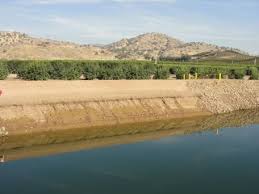
The most traditional and widely used method involves constructing an earth fill crest extension using locally available soils, without incorporating structural materials such as geosynthetics or precast components. This method is based purely on geomechanical principles, involving appropriate layering, compaction, and quality control of geotechnical parameters. Key aspects include proper compaction of each layer, ensuring slope stability, and conducting filtration analyses under steady-state and transient flow conditions post-augmentation.
Disadvantages: Requires widening of the embankment base; significant space requirements; risk of post-construction settlement.
Advantages: Low material cost, easy availability of fill material.
3.2. Use of Geosynthetics
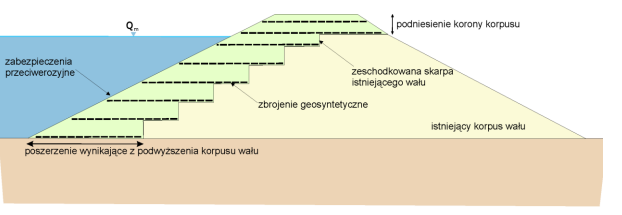
Geosynthetics—such as geogrids, geomembranes, geotextiles, and geocomposites—can reinforce the embankment crest extension, enhance structural stability, control seepage, and minimize filtration.
Disadvantages: Requires specialist installation; higher unit costs.
Advantages: Reduced layer thickness, improved mechanical performance.
3.3. Reinforced Concrete Cappings and Precast Elements
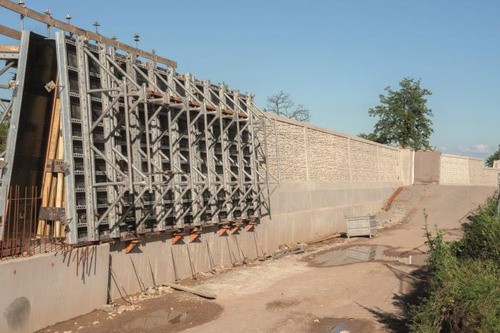
Applied in scenarios where lateral expansion is constrained or where high mechanical durability is required—such as in industrial or technical reservoirs.
Disadvantages: High cost, potential difficulties with expansion joints and watertightness.
Advantages: High durability, small spatial footprint, fast installation using prefabricated modules.
3.4. Steel Sheet Piles
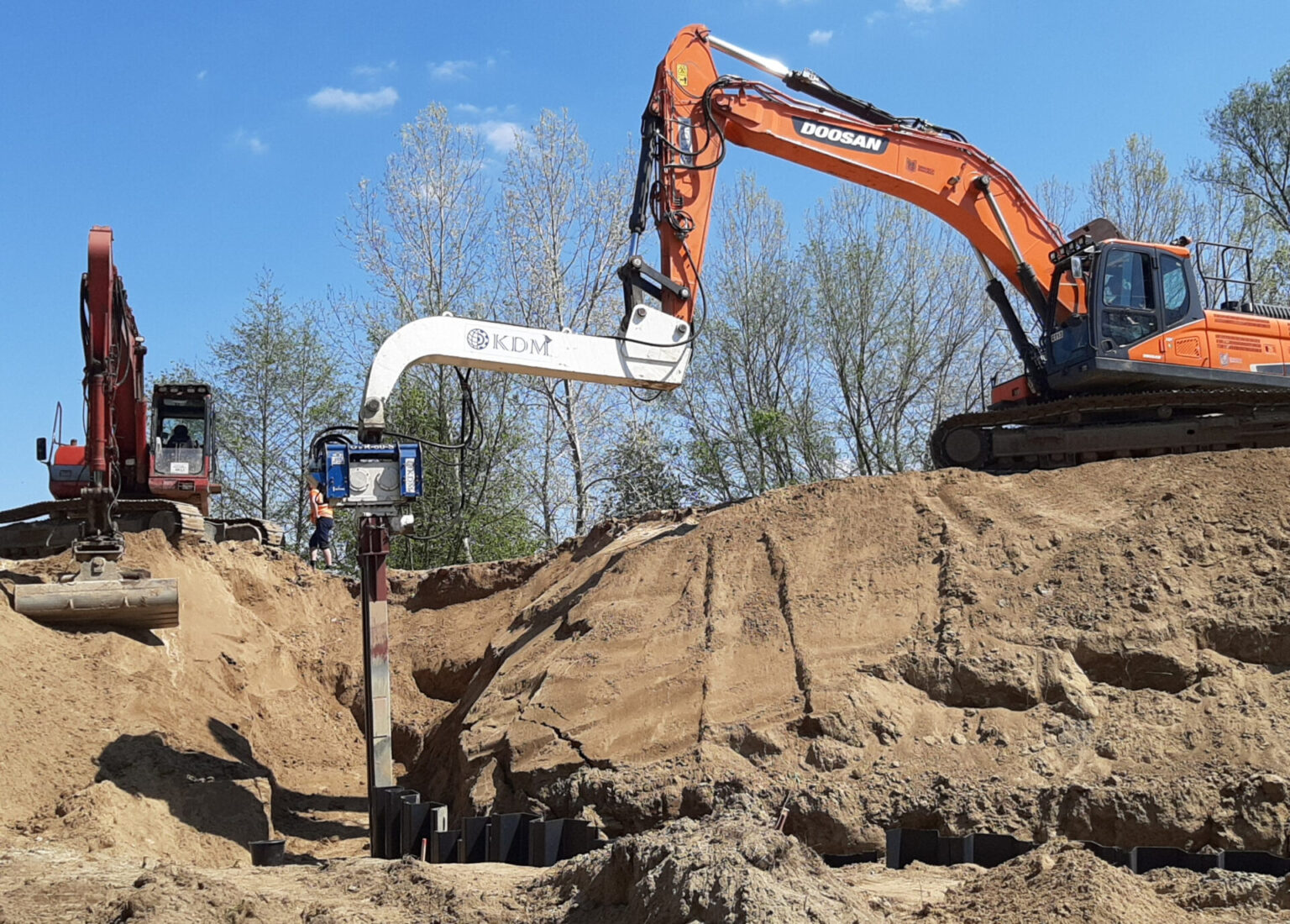
Steel sheet piles (e.g., Larsen-type) are a commonly applied solution in hydraulic and water engineering. Their primary function is to seal the embankment body and facilitate crest elevation without increasing the embankment footprint.
Disadvantages: Requires heavy construction equipment; susceptible to corrosion in aquatic environments.
Advantages: Very high mechanical strength; suitable for deep cut-off walls; capable of withstanding high hydrodynamic pressures.
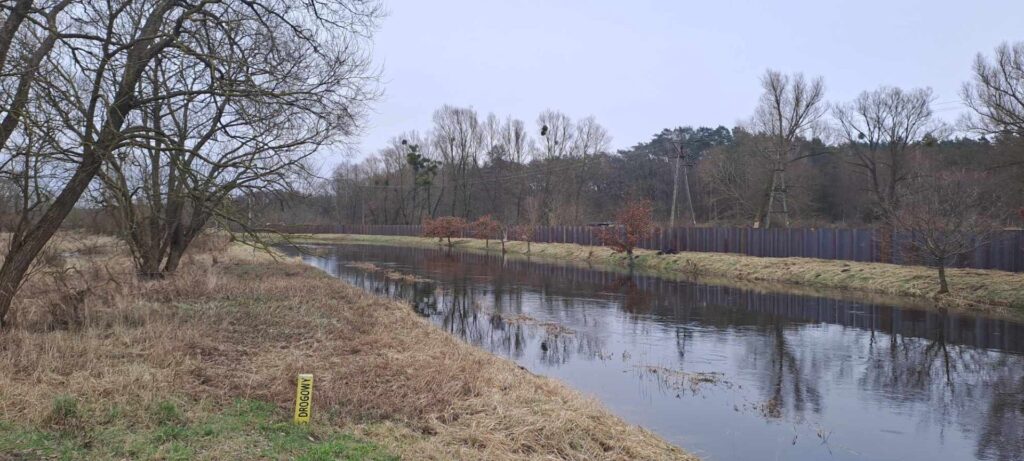
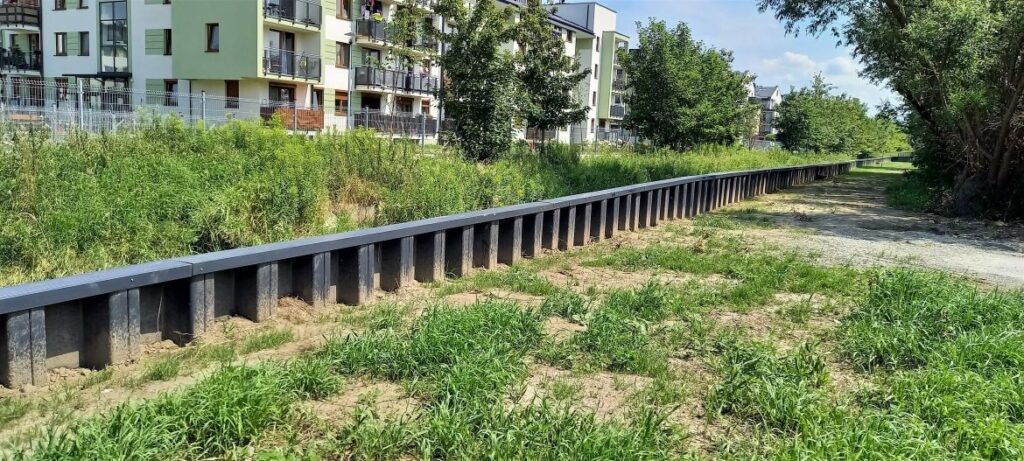
3.5. Vinyl (PVC) Sheet Piles
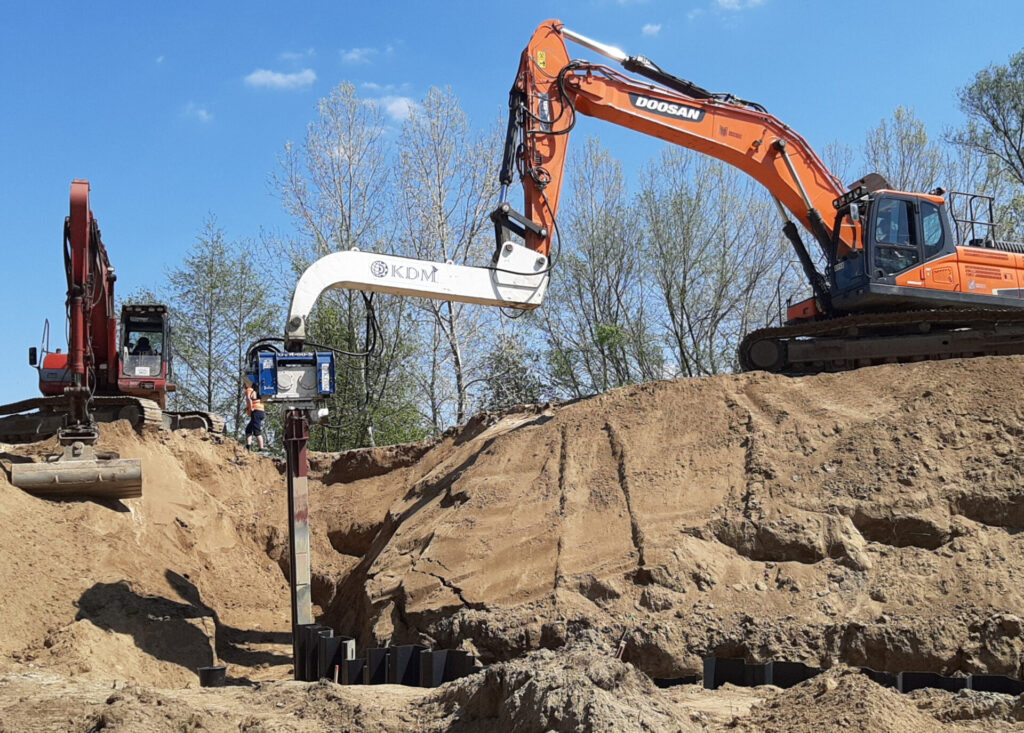
Vinyl sheet piles are lightweight synthetic interlocking panels primarily used for sealing and elevating embankments under moderate loading conditions.
Disadvantages: Limited section lengths; lower mechanical strength; longer profiles may require steel guide structures.
Advantages: Corrosion and UV resistant; low weight; simple installation without heavy machinery; visually aesthetic.
4. Comparative Analysis
This section compares the selected embankment raising technologies based on four core criteria: cost, durability, construction complexity, and required spatial footprint. This comparative framework supports the selection of the most appropriate method based on local conditions and project budget constraints.

Tradycyjna nadbudowa wału ziemnego cechuje się najniższym kosztem, lecz wymaga największej przestrzeni i jest najbardziej czasochłonna. Zastosowanie geosyntetyków oraz prefabrykowanych elementów pozwala znacząco skrócić czas wykonania i zmniejszyć wymagania terenowe, jednak kosztem większych nakładów finansowych. Ścianki stalowe wyróżniają się wysoką trwałością i nośnością, jednak w środowisku wodnym są szczególnie podatne na korozję, co może istotnie wpłynąć na ich żywotność i koszty utrzymania. Ścianki winylowe są odporne na korozję i UV, lecz można je stosować wyłącznie w projektach, gdzie nie występują duże siły parcia – ze względu na ograniczoną sztywność i nośność konstrukcji wykonanych z profili termoplastycznych.
Conventional earth fill extensions remain the most cost-effective option, albeit space- and time-intensive. The use of geosynthetics and precast elements significantly reduces construction time and spatial requirements but involves higher capital expenditure. Steel sheet piles offer high structural strength but are vulnerable to corrosion, which can impact lifecycle costs and durability. Vinyl sheet piles present a corrosion-resistant, lightweight alternative, but are limited in load-bearing capacity and stiffness, making them suitable only for moderate load applications.
5. Summary
This article presents a technical review and comparative analysis of selected technologies for raising retention reservoir embankments. Both traditional and advanced methods are evaluated, including geosynthetic reinforcement, concrete precast systems, and both steel and vinyl sheet pile walls. The analysis is based on four key selection criteria: cost, durability, implementation complexity, and spatial requirements.
Earth fill extensions offer the lowest upfront cost but demand the greatest space and time. Geosynthetics and prefabricated elements provide faster construction and enhanced durability, albeit at a higher cost. Steel sheet piles are structurally robust but prone to corrosion in hydraulic environments. Vinyl sheet piles provide a corrosion-resistant and easy-to-install solution, though limited to lower-load applications due to their reduced stiffness.
Technology selection should always be preceded by a detailed assessment of site-specific technical, spatial, and economic conditions, with a strong emphasis on long-term durability, watertightness, and safety of the hydraulic structure.
6. References
- Hurtland Sp. z o.o. (2018). Modernizacja wałów przeciwpowodziowych – zastosowanie maty bentonitowej Bentomat. [online] [Accessed 29 Jul 2025] https://hurtland.eu/wp-content/uploads/2018/09/Modernizacja_walow_walow_przeciwpowodziowych_bentomat_mata-bentonitowa.pdf


